

 My account


 Menu
Menu 

New data shows under-25 card issuance rose by 8.8% between 2023 and 2025, outpacing the rest of the carded workforce, with nearly one in six young entrants now holding a skilled or advanced skilled card
New figures published by the CSCS Alliance today show that cards issued to workers under the age of 25 rose by 8.8% between 2023 and 2025, jumping from 86,798 in 2023 to 94,444, with growth led by the electrotechnical, utilities and plant sectors.
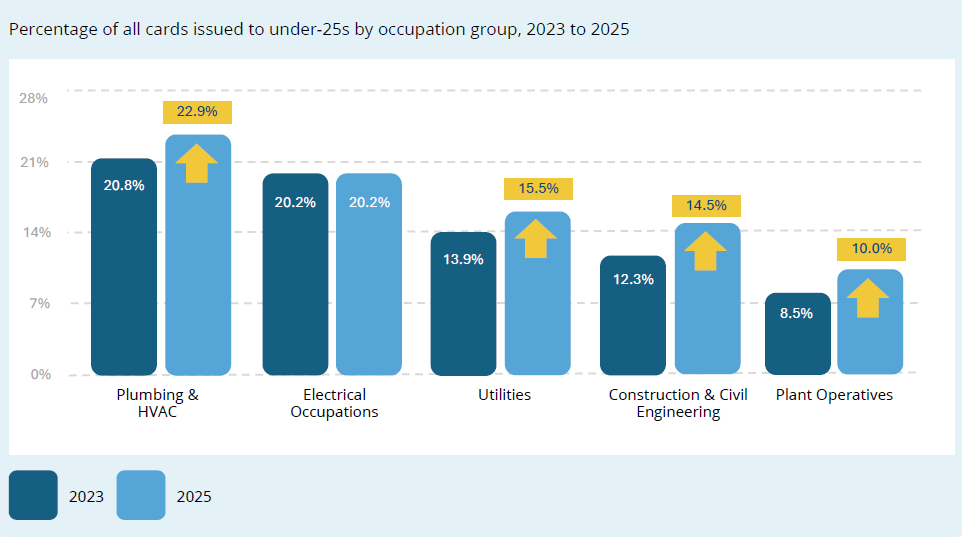
Today’s publication is the most comprehensive dataset made available via the CSCS-logoed card schemes, with under-25s now accounting for 19% of all cards issued, up from 17.2% in 2023 – despite a 1.3% drop in overall cards being issued.
Skilled and Advanced Skilled cards grew by 7.8% over the period to almost one in six cards issued to under-25s during 2025.
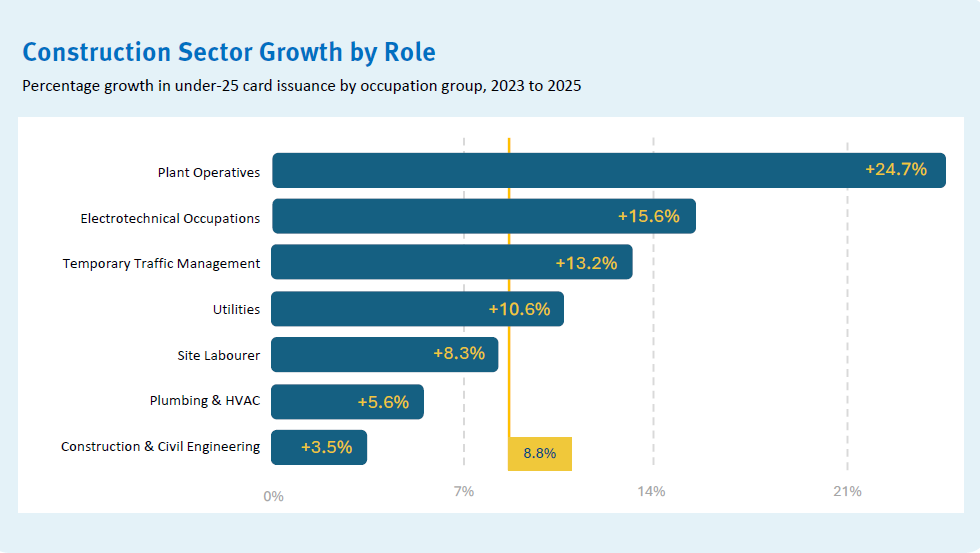
Growth in skilled roles (9.6%) outstripped labouring occupations (8.3%) by 1.3%, suggesting younger entrants are increasingly entering a broader range of occupations either in training or at a skilled level.
In terms of growth, Plant Operatives saw the largest rise in under-25 card issuance of any major occupation group – up 24.7% over the period – while Electrotechnical Occupations grew by 15.6% and Temporary Traffic Management by 13.2%.
Utilities also grew strongly, with its under-25 share rising from 13.9% to 15.5% across the three years.
By volume, Electrotechnical Occupations remains the largest sector group for under-25s, followed by Utilities and Construction & Civil Engineering trades, which includes occupations such as carpentry, joinery and bricklaying, despite the latter seeing a more modest growth rate of 3.5%.
Plumbing and HVAC, while smaller in total numbers, has the highest proportion of under-25s of any major skilled occupation group – standing at 22.9% in 2025, nearly one in four cards issued in that trade went to a worker under the age of 25.
CSCS Group Chief Executive Sean Kearns said: “This data is an encouraging sign for the industry. More young people are choosing careers in construction than in recent years, across a broad range of occupations, and an increasing proportion are entering the sector with skilled and advanced qualifications. That is exactly the direction of travel the industry needs if it is to meet future workforce demands.
“However, momentum alone is not enough. We must ensure that young entrants are supported from day one to develop the skills, competence and experience that will sustain long-term careers in construction and the built environment.”
“Getting people onto the right carding pathway from the outset is a key part of that journey. Cards should accurately reflect an individual’s skills and qualifications while supporting their progression through the industry. By aligning carding with competence and career development, we can turn these positive trends into the highly skilled workforce the industry needs to thrive in the years ahead.”
Analysis of under-25 cards by postcode area also gives a geographical flavour of where young entrants on skilled or training cards are most active. As of January 1st 2026, the highest volumes of such cards held by under-25s were recorded in:
Birmingham (B): 6,611 cards
Glasgow (G): 4,110 cards
Sheffield (S): 3,763 cards
Newcastle upon Tyne (NE): 3,121 cards
Manchester (M): 2,869 cards
The analysis follows Alan Milburn’s recent review of youth employment, which put the number of 16 to 24-year-olds not in education, employment or training at more than one million – a lost generation, in his words – at risk of being left further behind without urgent reform.
The National Audit Office’s report on increasing construction skills, published last week, found that up to 755,000 additional workers could be needed by 2030 to deliver government commitments on housebuilding, infrastructure and the Warm Homes Plan — and that departments need better data to understand the range of skills and entry routes the sector will require. CSCS Alliance data provides one part of that picture.
CSCS Alliance Chair, Marion Marsland, said: “Construction is already part of the answer to one of the country’s most pressing challenges — getting young people into skilled, sustainable careers.
“At a time when more than a million 16 to 24-year-olds are not in education, employment or training, this data demonstrates that the industry can attract and develop young workers at scale, and across a genuine range of trades and skill levels. The Alliance is committed to building on these foundations across all of its member schemes.”
Download the full report – Under 25s in Construction and the Built Environment